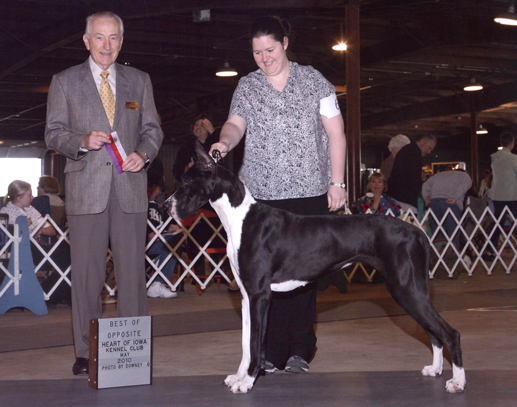
The first day’s picture didn’t turn out all that well, but I like the second day’s picture (pictured first below)..
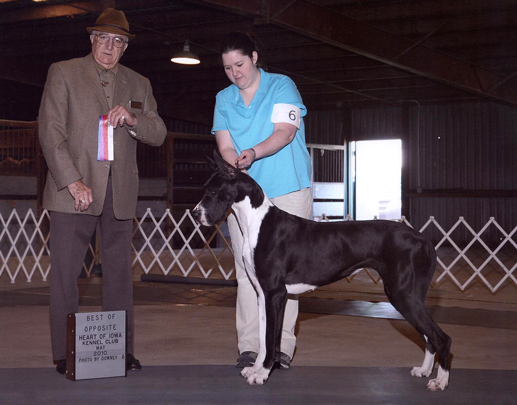
Horrible stack job by me!
Great Dane Breeder; Bing the Great Dane
The first day’s picture didn’t turn out all that well, but I like the second day’s picture (pictured first below)..
Horrible stack job by me!
Kizzy picked up two more points, going Winners Bitch and Best of Opposite both days in Marshalltown. Picture hopefully coming soon!
Kizzy also had her x-rays done for hips, elbows and patellas. Everything looked great on the x-rays, so now we’re just waiting for the OFA expert review. I will post link to her OFA results as soon as they are available.
Great Danes have four recommended health tests prior to the decision to breed them – hips, thyroid, cardiac and eyes. A breeder might choose to do additional tests as well.
These health tests go beyond a simple “well dog” check-up at the vet. While a dog might not exhibit any signs of a health issue, they can still pass problems to offspring. They might be a carrier of the problem; might not be exhibiting symptoms yet; or even have a non-symptomatic level of the problem (and paired with the wrong breeding mates, the puppies could then be symptomatic).
Health tests aren’t about getting the best rating, they’re about knowing what potential issues your dog may pass on to offspring and how to make smart breeding choices. The more information a breeder has – on the breeding candidate and their relatives – the more informed their breeding decisions.
For hips, a vet takes an x-ray and then the x-rays are submitted to OFA, PennHip, or OVC. I am only familiar with OFA, but will say that putting the dog under anesthesia is not required for the x-rays. I spent around $250 for Kizzy’s x-rays and OFA submission (this included all the costs for the hips, elbows and patellas).
For thyroid testing, any vet can draw the blood sample and then it is sent to an OFA approved lab for testing.
For cardiac testing, a board certified cardiac specialist is required. This screening can not tell you if the dog will ever come down with a heart problem, but it can detect current problems, big and small.
For eyes, again a specialist is required. A board certified veterinary ophthalmologist examines the dog’s eyes for any eye issues (e.g. cataracts, eye lid issues, etc.) and the results are sent into CERF, whose database is linked with OFA. For breeding dogs, eye CERFs should be repeated as the dog ages. I just had Skyy’s CERF done again and spent $30 on the exam an additional $8 for CERF submission.
Once a Great Dane has these four tests completed and the results are public, the dog earns a CHIC number. A dog does not have to “pass” these tests in order to receive a CHIC number, however the owner has to be willing to share good and bad testing results.
A CHIC number is not necessarily indicative of good health, rather the owner’s support of the open health database, which benefits our breed. By allowing the information to be publicly available, owners of related dogs gain perspective when making their breeding choices. Having a health issue arise should not be a dirty little secret – only by sharing the test results can the breed move forward.
Always verify any claims of health testing – OFA’s online database – before purchasing a puppy.
Congratulations to Greta and her owners Chris & Christine for her new CGC!! They have also been training Greta to track and have been busy training for Rally Obedience.

Congratulations to Bree and Tiana for Bree’s second point, picked up today in Waterloo, Iowa! Bree went Winners Bitch and Best of Opposite.
Most all of our snow is gone, leaving behind lots of fun mud!
Skyy spattered with mud:

The reason she is spattered with mud:

Kizzy being Kizzy:


Skyy might be six, but she is still a puppy at heart!


Tiana does such a wonderful job showing Miss Bree! Here is their win pic from her first point:

Kizzy recently earned her CGC. For those unfamiliar with the CGC, here is the post I wrote when Grace earned her CGC.

Bree won her first point by going Winners Bitch/Best of Opposite Sex at the Cyclone Kennel Club show on Sunday of this past weekend. Yay Bree!! She also went Reserve on Saturday. Kizzy took Reserve to her sister on Sunday. Pictures forthcoming!
Thank you to the members of the Central Iowa Kennel Club for honoring me with the AKC Outstanding Sportsmanship Award! 
One of the things I love most about showing dogs is all of the friends I’ve met. While the CIKC has had its fair share of bumps in the road, we’ve persevered and the club is thriving. I enjoy working with my fellow club members to benefit the sport of purebred dogs.
For anyone looking to start showing dogs, go get involved in a club. You’ll learn so much about showing and met great folks along the way.
CIKC has many dedicated and wonderful members. I’m very flattered to be selected as our first club recipient of this award.
Our Christmas pic this year:

Not an easy feat to get both dogs and kids in a halfway decent picture. The cat kept escaping our photo shoot, so he got his own pic:

Welcome to winter! We have had over a foot of snow dumped on us over the last few days! The interstate was closed between us and Des Moines for most of yesterday and, of course, the area schools were all closed.

Kizzy loves the snow (any excuse to run madly about the yard), but Skyy is more content inside. Skyy would much rather bake in the summer sun!


I took the stitches from Kizzy’s gastropexy out yesterday and the incesion looks great.

As many people know, Great Danes are the number one breed at risk of Gastric Dilatation and Volvulus, (GDV) commonly known as bloat and torsion.
Bloat is when the stomach fills with gas, then the stomach flips (torsion/volvulus), cutting off blood supply to the stomach, which causes the stomach to start to die. Often, the spleen and major blood vessels in the area twist as well. This causes the dog to go into shock. Bloat episodes can often be fatal and progress quickly. Immediate veterinary assistance is imperative.
It should be noted that the cause of bloat is unknown. I’ve heard of some Dane owners that restrict exercise for an hour before and an hour after eating. Personally, I find that excessive. Considering the fact I work during the day and feed my dogs twice daily, if their exercise was restricted for four hours each day, they wouldn’t ever have time to play! If they’ve been on a run before a meal, I make sure they’ve had the chance to cool down before I feed them. I also would not take them on a big run right after eating.
There have been claims that feeding from a raised dish either prevent or cause bloat, I don’t subscribe to either belief.
There are various other theories, but when it comes down to it, there is not a way to prevent bloat. The best course of action is to become familiar with the symptoms of bloat and know your vet’s emergency procedures. Check out Ginnie Saunders’ Bloat Links for more information on bloat. The Great Dane Club of America has a helpful Bloat Chart available, too.
There is a preventative surgery, called a gastropexy, that will hopefully help prevent torsion, the fatal part of a bloat episode. This will not stop a dog from bloating, but it should buy the owner time in getting the dog to the vet and might even save the dog’s life.
This past Monday, I took Kizzy in for a Prophylactic Gastropexy. Prophylactic means preventative. (Gastropexies are also done during emergency bloat surgeries.) A gastropexy (gastro = digestive system; pexy = surgical fixation) adheres the stomach to the body cavity. Even if your dog has had a “pexy”, if you suspect your dog is bloating, seek emergency vet care.
We recommend gastropexies on Great Danes after 18 months of age. We avoid doing the pexy on immature Danes as their bodies grow and change so much before maturity.
There are various gastropexies methods. We opt to do a Laparoscopic-Assisted Gastropexy (LAG). The advantages to doing this laparoscopically are the small incisions and quick recovery time.
 Laparoscopic-Assisted Gastropexy
 Laparoscopic-Assisted Gastropexy (LAG)
 LAG procedure – grasping the stomach
 Kizzy’s gastropexy adhesion
I drive to Morris, IL (4 hours one way) to Pine Bluff Animal Hospital to have Dr. Brian Schmidt perform the surgery. Dr. Schmidt has performed hundreds of these surgeries on Danes.
The hardest part of the gastopexy experience is keeping the dog quiet for a week post op! The dogs tend to recover quickly and want to be back to playing and running like normal. Too much exercise too soon after the surgery can cause lots of swelling at the sight of the incision (some swelling is normal) as well as interfere with the quality of the adhesion.